ArtGate-Ink Recommendations
But what is colour theory?
The Interaction Design Foundation gives a pretty good definition of what colour theory is: “Color theory is the collection of rules and guidelines which designers use to communicate users through appealing colour schemes in visual interfaces.” To simplify is a logical structure that covers the subject: the colour wheel, the harmony and the context of colour use.
Selecting the best colour combination as an artist, designer, decorator, or visual merchandiser is enough to start using the colour wheel, the colour harmony suggestions and psychology rules as far as the knowledge about human optical ability and cultural background.
The history of the theory of colour goes back to ancient years and the Peripatetic School of the Greek philosopher Aristotle (384-322 BCE) who wrote in collaboration with their students a document with the title On Colours. Observing nature they support that all colours were composed of brightness and darkness based on the duality of day and night and they believed that there were two basic colours: yellow and blue Based on those primary colours, the Peripatetic School created a linear light colour theory and added four further colours in correspondence to the four elements (earth, fire, wind, and water): green, red, yellow, and blue.
On the other side of Aristotle who was based on pure observation was the emblematic Arabian scientist and philosopher Hasan Ibn al-Haytham (965-1040 CE) one of the firsts who insisted that everything must be proven with scientific approaches, tested his light and colour theory conducting experiments. Following his experiments with glass spheres full of water, he discovered that light was divided by the water at multiple angles to produce different colours of the rainbow. His book The Book of Optics concluded that vision occurs once the light is given off the sun and other luminous sources or reflection into the eye.
Centuries later comes Isaac Newton, redefined the theory of light and colour. In his work Optiks (1704) after experiments based also on Hasan Ibn al-Haytham’s work, he proved that colour was composed of white light alone, and not of back, and wight light. Later, however, following further experiments discovered that the rainbow is a continuous spectrum of colour, he remains with his seven-colour concept and created the first colour wheel, based on the glass prism that produced a colour spectrum ranging from red to violet, and he concluded that the various colours were produced by several wavelengths.
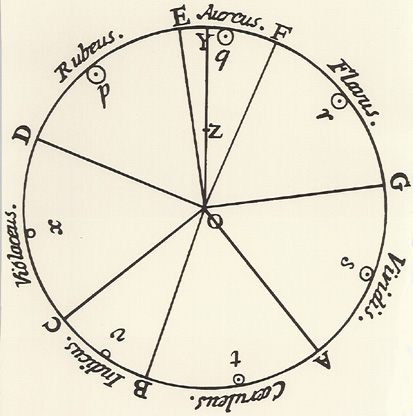
Newton’s color wheel from Optiks (1704). Arranged within a pattern of an octave.
So… What to Read to Learn more about Colour Theory?
The Classic Books
- Theory of Colours (1809-1810) by Johann Wolfgang von Goethe.

Publisher: MIT Press Ltd (1970)
Even if Goethe’s theory on colours has been criticised many times by the scientific community, this book remains a must-read as the poet and philosopher offers an alternative perception of colours. This book is considered the first attempt at a systematic study of the psychological impact of colours. He particularly talked about the effect of colour combinations with an emphasis on the dramatically opposed colours and the possibility to enhance each other if placed side by side. In addition, Goethe had an issue with Newton’s colour spectrum and decided to incorporate his own beliefs into Newton’s colour wheel. In fact, his most radical point was against Newton’s. Goethe supported that darkness was not a passive absence of light, but an active ingredient.

Johann Wolfgang von Goethe, Theory of Colours, c 1809-1810, pen and black ink, watercolored on yellowish paper, mounted on cardboard, Frankfurt Goethe Museum, Frankfurt, Germany.
- The laws of contrast of colour (1861) by Michael Eugene Cherveul’s.
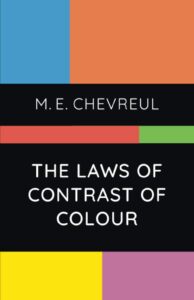
Pubblisher: Independently published (2020)
The theories of the French chemist Michael Eugene Cherveul became the base for impressionist and neo-impressionist painting. Especially the pointillists Georges Seurat and Paul Signac. Chereveul developed the theory of the effect of simultaneous contrast which defines the tendency of the colour to shift the one close to it, in terms of hue and darkness. In this book are presented principles to apply in an extensive variety of visual arts and more. From design, carpets, furniture, museums, apartments, theaters, and typography, to texture and fashion.
- Color Problems: A Practical Manual for the Lay Student of Color (1901), by Emily Noyes Vanderpoel.

Pubblisher: Sacred Bones Books (2018)
The artist Emily Noyes Vanderpoel made a study that provides an extensive look at colour theory ideas of the early 20’century. She presents her poetic analytical methods for colour, almost an interpretation of colours’ effects in the imagination, giving details of colours’ relationship in everyday life objects like teacups and saucers. Vanderpoel to publish the book used the guise of flowers and decorative arts as subjects, the onlies appropriate for a woman. Vanderpoel’s research-based techniques, -as happened with many other women in the arts during the previous centuries-, were used by men artists without ever mentioning her. The New York Watercolour Club has a policy to not accept women as members, but Vanderpoel managed to become its vice president.
- Interaction of Color (1963) by Josef Albers

Pubblisher: Yale University Press; 50th Anniversary edition (2013)
This book written by the modernist artist Josef Albers teacher and theorist is considered the masterpiece in the theory of colour, especially in education. It’s a handbook full of visual exercises and a simplified explanation of the colour theory. Reading this book requires an investment of time as it is a learning process. The Fifty Years Anniversary Edition in addition is expanded with a selection of close to sixty color studies alongside the original text.
The “Newes” Books
- Colour and Meaning: Art, Science, and Symbolism (2000) by John Gage

Publisher: Thames & Hudson, (2000)
John Gage historian of art and colour, in this book, tries to answer if colour affects feelings and if it can be considered a physical phenomenon. It is examined under the conviction that the meaning of colour lies in a particular historical context in which it is experienced or interpreted. Trying to explore the mystery of colours as diverse as the optical mixing techniques refers to famous artists and how they absorb the experience of colours and light.
- Color Theory: An essential guide to color from basic principles to practical applications (2012) by Patti Mollica
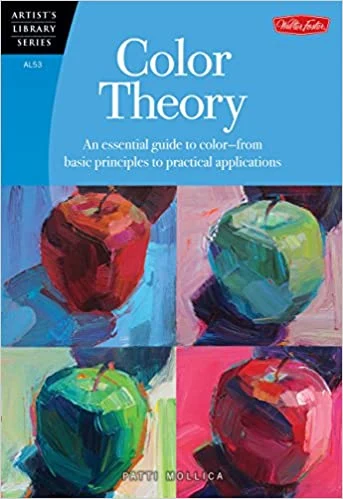
Publisher: Walter Foster Publishing (2012)
Patti Mollica artist and educator, in her more practical book on colour theory and how to apply it as an artist, gives a guide on colour, use, techniques, pigments especially oil and acrylic, and colour combination and colour psychology to have a vibrant, fresh, harmonious and meaningful result.
- Color Theory: A Crutical Introduction (2021) by Aaron Fine
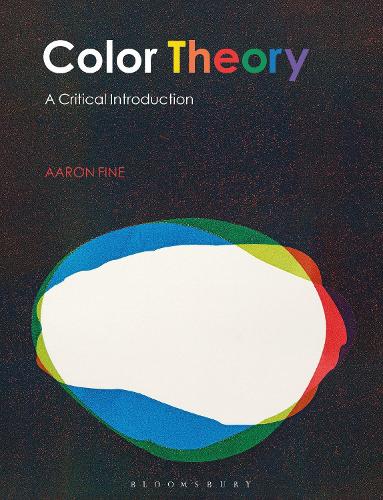
Publishing: Bloomsbury Publishing PLC (2021)
Professor of Art and artist Aaron Fine in this book goes from centuries, regions and disciplines to create a panoramic view of the guises that colour takes in society, art and philosophy offer a critical history of Western ideas on this subject. To succeed this analyses the colonialist and gendered attitudes, materialist perspective and spiritualist approaches to colour and the colour in the era of reproduction in modernist and post-modernist colour strategies.
The Colour and the World Books
- The World According to Colour : A Cultural History (2021) by James Fox
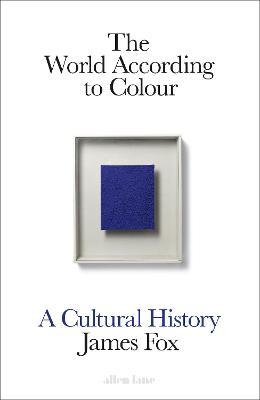
Publishing: Penguin Books Ltd (2021)
Art historian and BAFTA-nominated broadcaster James Fox writes a book that could be defined as an explanation of the relationship between human beings and colours. The historical role of colours in shaping cultures and the related meanings that people invent. An alternative trip in art history from the Bronze Age gold works to William Turner, Titian (Tiziano) to Yves Klein.
- Colour and Culture : Practice and Meaning from Antiquity to Abstraction (1995) by John Gage

Publisher: Thames & Hudson Ltd (1995)
For John Gage colour is a fundamental and significant part of life and art, and this book tries to give answers on what the language of colour conveys, and what is the function of light and materials. He analyses colour in Western culture from the ancient Greeks until the late 20th century, referring to philosophers from ancient years till today and how they tried to systematically organise colour in theory in the context of symbolic power.
A book on the History of Colour in Art
- Colours of Art: The Story of Art in 80 Palettes (2022) by Chloë Ashby

Publisher: Francis Lincoln Publishing (2022)
Last but not least, an emblematic book by Chloë Ashby takes a journey in the history of art through 80 curated artworks and the analysis of their palettes. A guide to understanding how artists engaged their pigments with social, political, and religious references and how the colour becomes an individual characteristic for artists. Starting from prehistoric and ancient years covers all the evolution of colour in art till contemporary art, today.
Ashby, C. 2022, Colours of Art: The Story of Art in 80 Palettes. Francis Lincoln Publishing, London, UK.
https://www.colormatters.com/color-and-design/basic-color-theory
https://www.interaction-design.org/literature/topics/color-theory
https://pigment-pool.com/the-history-of-color-theory-must-know-facts-for-creatives/
https://www.amazon.com/Contrast-Colour-Michel-Eug%C3%A8ne-Chevreul/dp/B08JLXYKRZ
https://www.thisiscolossal.com/2018/07/color-problems-by-emily-noyes-vanderpoel/
https://www.artnews.com/art-news/product-recommendations/best-color-theory-books-1202694928/
https://www.amazon.com/Interaction-Color-Anniversary-Josef-Albers/dp/0300179359
https://www.amazon.it/Color-Theory-Patti-Mollica/dp/1600583024
https://www.bloomsbury.com/us/author/aaron-fine/
https://www.amazon.com/Color-Theory-Aaron-Fine/dp/1350027308
https://www.bookdepository.com/Colour-and-Meaning-John-Gage/9780500282151?redirected=true&selectCurrency=EUR&w=AFFMAU9SDQ7KRKA8YC5N&utm_source=google&utm_medium=cpc&utm_campaign=gr_shopping_performance_max&utm_content=gr&gclid=Cj0KCQiA6fafBhC1ARIsAIJjL8mKlJCokpNHf7v7B9XX5_nU1B5_6sNHuH86vPmAfzQp6P0A8mkk4xoaAgYpEALw_wcB